Aphasia rehabilitation after a stroke: how to recover speech, step by step
Post-stroke aphasia can be treated with real results, even years later. Find out what types of aphasia exist, what speech therapy involves, and how to communicate with someone who has aphasia.
When the words disappear
Few consequences of a stroke cause as much suffering as aphasia. The person affected still thinks clearly, understands what is happening around them, has things to say… but the words do not come out, or come out wrong, or come out in the wrong order. The gap between what is thought and what can be expressed can be a devastating kind of loneliness.
For families, aphasia is very hard too: the person they knew is still there, but the communication that was the heart of the relationship has broken down. Learning to communicate again —together— is one of the most demanding and also one of the most meaningful parts of the recovery process.
The good news is that aphasia can be treated. And in many cases it can improve significantly, even years after the stroke.
What is aphasia? Types, and how it differs from dysarthria
Aphasia is a language disorder caused by damage to the areas of the brain that handle language, usually in the left hemisphere. It is not a disorder of intelligence or of the ability to think: thought can be entirely intact while access to language is damaged.
There are several types of aphasia, differing in which aspects of language are most affected:
- Broca's aphasia (expressive): difficulty producing speech. The patient understands what is said to them but struggles to express themselves. Speech is slow, effortful, and function words are left out.
- Wernicke's aphasia (receptive): difficulty understanding language. The patient speaks fluently but produces sentences that make no sense or that substitute the wrong words (paraphasias).
- Global aphasia: severe impairment of both comprehension and expression. It is the most serious form.
- Anomic aphasia: difficulty mainly in finding specific words (anomia). It is the mildest and most common form.
Dysarthria is different: it is a speech disorder caused by weakness or poor coordination of the muscles involved in producing sound, not by damage to the language areas. Someone with dysarthria can find the right words but has difficulty articulating them clearly. Many stroke patients have both aphasia and dysarthria.
Can speech be recovered after a stroke?
Yes, although how much recovery there is varies a great deal depending on the type and extent of the lesion, the time elapsed and the intensity of treatment. What the evidence shows clearly is that:
- Most people with aphasia improve if they receive specific speech therapy.
- Recovery is faster in the first few months, but it can continue for years.
- The intensity of treatment is decisive: more hours of speech therapy translate into better results.
- The patient's motivation and the family's involvement speed up the process.
A study published in Stroke showed that patients with chronic aphasia (more than a year on) who received intensive speech therapy significantly improved their ability to communicate. The idea that «after a year, speech cannot come back» is simply wrong.
The aphasia rehabilitation process: what happens in the sessions
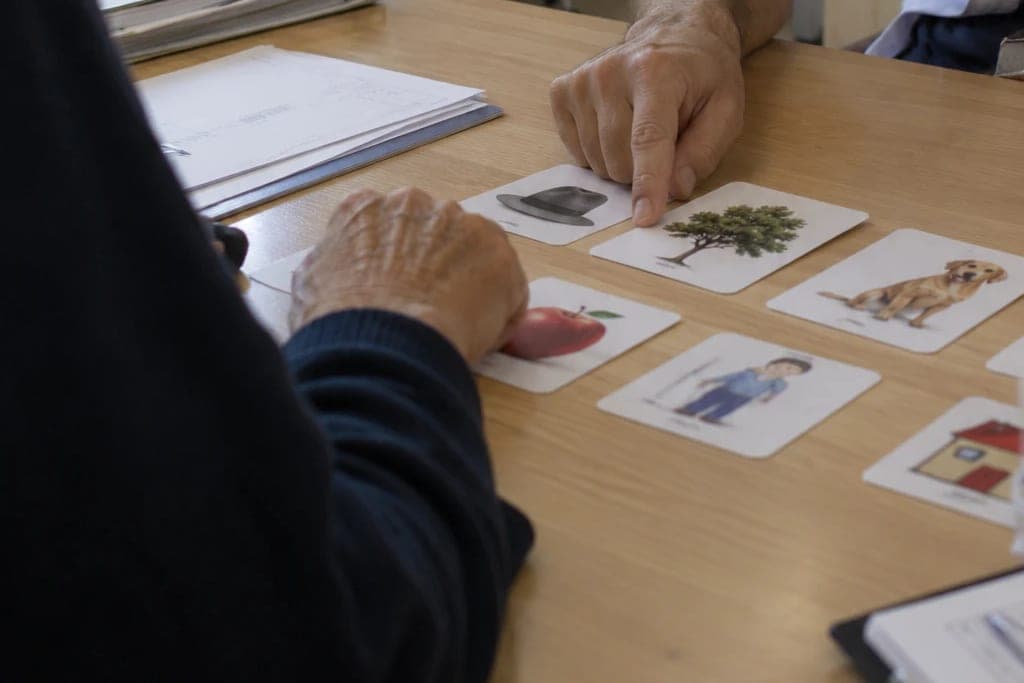
Speech therapy for post-stroke aphasia is not about «practising talking» in some general way. It is a specific, structured treatment that works on the damaged linguistic processes. Sessions can include:
- Naming work: exercises to recover access to specific words, particularly the most frequently used ones.
- Phonological processing: work with the sounds of language and how they map onto words.
- Listening comprehension: activities to improve the ability to understand spoken language.
- Reading and writing: rehabilitation of alexia (difficulty reading) and agraphia (difficulty writing) where these are present.
- Functional communication: strategies for communicating effectively in real life, combining speech, gesture, writing and visual supports.
- Work with the family: teaching relatives communication strategies that make everyday interaction easier.
Chronic aphasia: when speech has not improved years after the stroke
Many people with post-stroke aphasia receive speech therapy during the first few months and then lose it when they are discharged from rehabilitation. If the aphasia persists at that point, it is often left untreated for years, on the implicit assumption that there is no room left for improvement.
This situation is more common than it should be, and it represents a missed opportunity. Patients with chronic aphasia who get access to intensive speech therapy —even years after the stroke— can improve their communication significantly and take a fuller part in social and family life.
The key is for the treatment to be specific, intensive and consistent, and coordinated with the rest of the rehabilitation team.
How to communicate with someone who has aphasia: practical advice for families
- Speak slowly and in short sentences. Do not raise your voice: aphasia is not a hearing loss.
- Give them time to answer. Someone with aphasia needs more time to process and produce language. Resist the urge to finish their sentences.
- Use visual supports. Pointing at objects, using photos or writing down key words helps enormously.
- Check that you have understood. Repeat back what you think you have understood, to confirm it.
- Treat an adult as an adult. Aphasia does not reduce a person's intelligence or dignity. Avoid speaking to them as if they were a child.
- Keep up ordinary conversation. Informal chat, imperfect as it may be, is part of language rehabilitation.
Aphasia treatment at Foltra
At Centro Sanitario Foltra, neurological speech therapy is an integral part of the stroke rehabilitation protocol. We work with patients with aphasia at every phase —acute, subacute and chronic— with a high-intensity approach coordinated with the physiotherapy and neuropsychology team.
If the patient has persistent aphasia and has not had intensive speech therapy, or has gone a long time without progress, it may be worth exploring whether a specialist approach can bring improvements. You can find out more in our section on stroke and brain injury rehabilitation, or request an initial assessment.